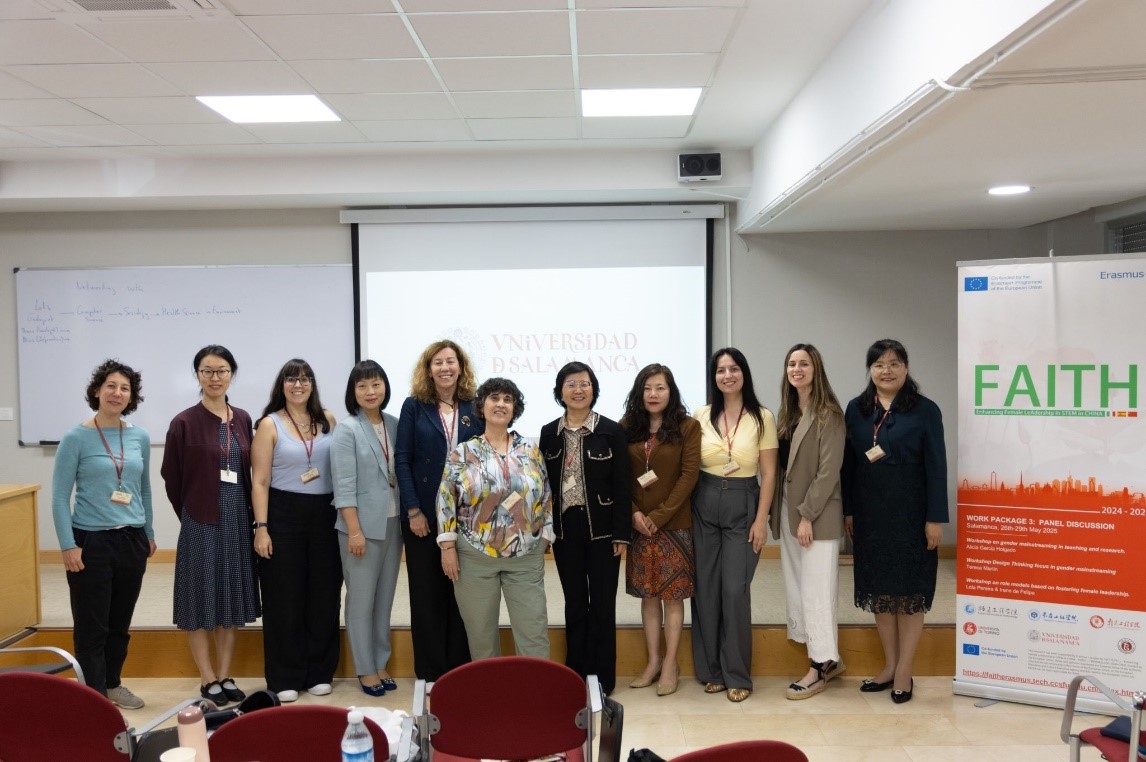
From May 25 to 31, 2025, a delegation led by Wang Qun, Member of the University Council and Vice President of Nanjing Institute of Technology, visited the University of Salamanca in Spain to participate in the academic seminar of the Erasmus+ project “Enhancing Female LeAdership In STEM in CHINA (FAITH).” The event brought together professors and scholars in STEM fields from China, Spain, and Italy to explore innovative practices in cultivating female talent and leadership in STEM disciplines.
During the seminar, participants engaged in in-depth discussions on key topics such as “Establishing Female Role Models in STEM to Promote Women’s Leadership Development,” “Current Status of Chinese Female Scientists’ Participation in STEM Fields,” and “How to Inspire Female Students’ Interest in STEM Engagement” through various formats, including keynote speeches, roundtable forums, and brainstorming sessions.
This visit represents one of Nanjing Institute of Technology’s key initiatives to deepen international exchanges and cooperation. Wang Qun emphasized that the university will actively integrate the advanced ideas shared during the seminar and focus on advancing the following three measures:
First, in accordance with the project requirements, the university will pilot a “FAITH Class,” offering multiple courses in both “Science and Technology” and “Leadership” for eligible students based on established selection criteria.
Second, the university plans to establish a “STEM Women’s Talent Database” targeting students and teachers at critical stages of their academic and professional development, designing tailored support measures. Additionally, a “Women’s Leadership Discussion Group” will be formed to systematically enhance women’s participation and leadership in STEM fields through initiatives such as dual mentorship programs, international forums, and case studies.
Third, the university will continue to promote the development of the FAITH project, maintaining transnational exchanges and resource sharing with partner institutions such as the University of Turin in Italy and the University of Salamanca in Spain.
The delegation was accompanied by representatives from the School of Computer Engineering and the Office of International Cooperation and Exchanges.